
Geometry Word Searches 2
Shape Properties, Angles, Circle Parts, Coordinates & Geometric Reasoning
Part of the Discovery Word Search Collection
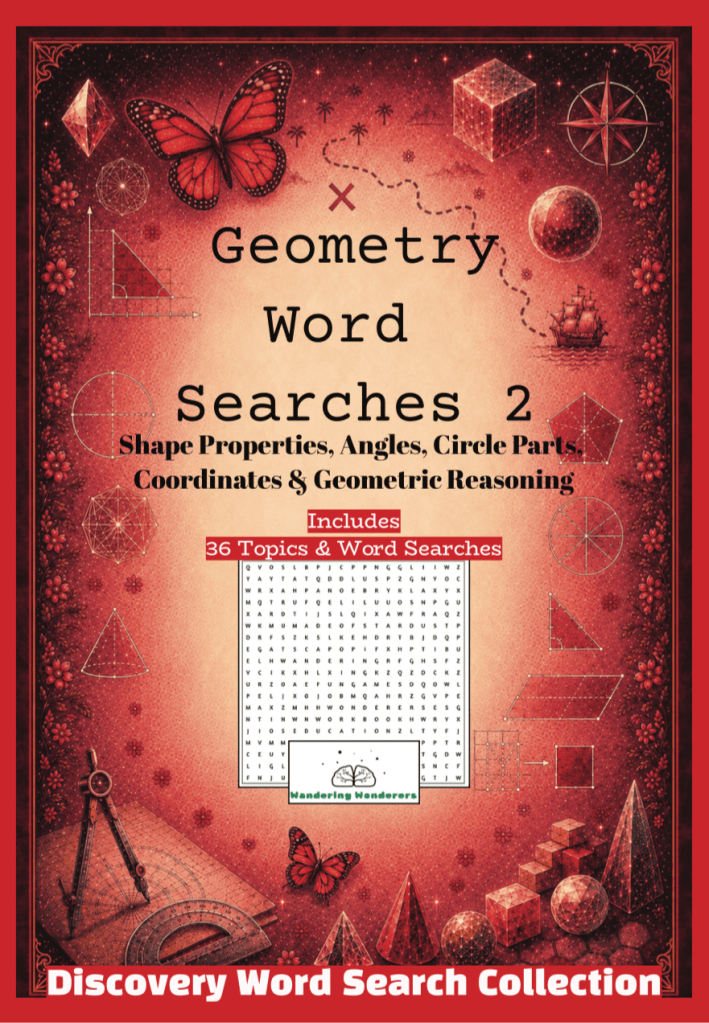
Step further into the world of geometry.
Geometry Word Searches 2 is a bright, engaging and educational puzzle book for curious learners who enjoy shapes, angles, patterns, maps, coordinates, drawing tools, and everyday maths discovery.
This book builds on the Discovery Word Search Collection style by combining simple topic information pages, themed word search puzzles, and gentle geometry-themed colouring pages.
Each section introduces important geometry vocabulary in a calm, accessible way before learners search for the words in the puzzle.
The aim is simple: to make geometry feel visual, manageable, creative, and enjoyable.
Rather than overwhelming learners with long explanations, Geometry Word Searches 2 breaks each topic into small, clear sections. Learners can read, notice, search, colour, and return to the ideas at their own pace.
It is designed for learners who enjoy puzzles, patterns, shape words, visual learning, careful observation, screen-free activities, and big ideas made simple.
What Is Inside Geometry Word Searches 2?
Inside this book, learners will discover 36 themed geometry topics.
Each topic includes simple educational pages followed by a word search puzzle. Geometry-themed colouring pages are also included to add a calm visual and creative layer to the learning experience.
The book explores words linked to shape properties, open and closed shapes, regular and irregular polygons, quadrilateral families, triangle types, angles, circle parts, scale drawings, transformations, symmetry, coordinates, drawing tools, and reasoning with shapes.
The topics included are:
- Shape Properties
- Open and Closed Shapes
- Regular Polygons
- Irregular Polygons
- Quadrilaterals
- Parallelograms
- Rhombuses
- Trapeziums
- Kite Shapes
- Equilateral Triangles
- Isosceles Triangles
- Scalene Triangles
- Acute Angles
- Obtuse Angles
- Reflex Angles
- Angle Measurement
- Intersecting Lines
- Diagonal Lines
- Line Segments
- Rays and Points
- Circle Parts
- Radius and Diameter
- Circumference
- Circle Lines and Arcs
- Scale Drawings
- Enlargement
- Reduction
- Similar Shapes
- Congruent Shapes
- Translation
- Rotational Symmetry
- Lines of Symmetry
- Coordinate Quadrants
- Ordered Pairs
- Drawing Geometry
- Reasoning with Shapes
Each word search introduces nine topic words. This keeps each puzzle focused, achievable, and suitable for learners who benefit from clear structure and manageable vocabulary.
A Gentle Way to Explore Geometry
Geometry is the study of shapes, space, lines, angles, patterns, positions, and the way things fit together.
For many learners, geometry begins with simple noticing.
A window with four corners.
A butterfly with symmetry.
A road sign with a clear shape.
A map with coordinates.
A clock face with angles.
A tile pattern on the floor.
A circle on a plate.
A triangle in a roof.
A shape that slides, turns, grows, or matches another shape.
Geometry Word Searches 2 uses this natural noticing as a starting point. The book encourages learners to look closely at the world around them and begin asking gentle questions.
What makes one shape different from another?
How can shapes be sorted into families?
What is the difference between an acute, obtuse, and reflex angle?
How can circles be measured?
What happens when a shape moves on a grid?
How can symmetry help us see balance?
How do maps, drawings, tools, patterns, buildings, and designs use geometry?
The book does not expect learners to master everything at once. It simply gives them words, ideas, and visual examples that can help them build confidence with geometry vocabulary.
How the Book Supports Learning
Geometry Word Searches 2 supports learning through a simple and repeated structure.
Learners meet the topic through short information pages.
They are introduced to key words.
They search for those words in the puzzle.
They may then explore the topic visually through colouring pages.
This repetition helps learners become more familiar with important vocabulary without pressure.
Word searches are useful because they encourage:
- focus
- spelling practice
- visual scanning
- pattern recognition
- letter recognition
- vocabulary familiarity
- careful observation
- persistence
- quiet concentration
For learners who find longer written tasks difficult, word searches can offer a more approachable route into educational content. The learner is still engaging with topic vocabulary, but in a way that feels playful and structured.
The colouring pages add another layer. They give learners time to pause, observe, and connect words with images. A colouring page about shape properties, triangle types, angle measurement, circle parts, coordinates, symmetry, transformations or drawing tools can help the topic feel more concrete and memorable.
This makes the book especially suitable for visual learners, reluctant readers, SEN learners, home-educated learners, and learners with strong special interests in maths, shapes, maps, patterns, puzzles or design.
Curriculum-Linked Learning
Geometry Word Searches 2 is not a complete curriculum textbook. It is a supportive enrichment resource that can sit alongside lessons, home education, tutoring, maths practice, revision, topic-based learning and independent curiosity.
The topics link particularly well with mathematics learning across primary and early secondary stages.
The book is especially useful for Key Stage 2 learners who are building and extending geometry vocabulary. It supports ideas linked to shape properties, polygons, triangles, quadrilaterals, angles, symmetry, coordinates, translations and drawing shapes accurately.
Some topics also offer gentle preparation for Key Stage 3 geometry. These include similar shapes, congruent shapes, scale drawings, enlargement, reduction, geometric reasoning, circle vocabulary, coordinate quadrants, and more precise mathematical language.
Topics such as Shape Properties, Open and Closed Shapes, Regular Polygons, Irregular Polygons, Quadrilaterals, Parallelograms, Rhombuses, Trapeziums and Kite Shapes help learners build confidence with describing and classifying shapes.
Triangle topics such as Equilateral Triangles, Isosceles Triangles and Scalene Triangles support learners in noticing side lengths, angles, and shape families.
Angle topics such as Acute Angles, Obtuse Angles, Reflex Angles and Angle Measurement help learners meet and revisit important angle vocabulary in a visual way.
Circle topics such as Circle Parts, Radius and Diameter, Circumference, and Circle Lines and Arcs introduce learners to the language used to describe round shapes more accurately.
Coordinate and transformation topics such as Translation, Coordinate Quadrants, Ordered Pairs, Enlargement, Reduction, Similar Shapes and Congruent Shapes help learners connect geometry to movement, position, scale and comparison.
The book supports cross-key-stage learning by helping younger learners meet foundational vocabulary, while allowing older learners to revisit and extend their understanding through a calm, low-pressure activity format.
Cross-Curricular Connections
Geometry is not only useful in maths.
It connects naturally with art, design, architecture, geography, map reading, construction, craft, engineering, computing, problem solving, and visual reasoning.
Learners may begin to notice geometry in:
- buildings
- windows
- doors
- bridges
- paths
- maps
- signs
- clocks
- tiles
- packaging
- patterns
- artwork
- nature
- puzzles
- games
- diagrams
- drawings
- everyday objects
A coordinate grid can link to map reading.
A pattern can link to art and design.
A scale drawing can link to architecture or planning a room.
A compass and ruler can link to careful drawing.
Symmetry can link to butterflies, leaves, faces, windows, and decorative design.
Angles can link to clocks, doors, roof shapes, scissors, turns, and movement.
Geometry helps learners see how maths is built into the world around them.
Play-Based Learning Through Word Searches
Play-based learning can be powerful because it lowers pressure.
When learning feels like a puzzle, learners can practise important skills without feeling as if they are being tested. Word searches encourage learners to slow down, scan carefully, notice patterns and return to key topic words again and again.
This can help with spelling, vocabulary, attention and confidence.
A learner may not remember every definition immediately, but they may begin to recognise words such as polygon, quadrilateral, rhombus, trapezium, acute, obtuse, radius, diameter, symmetry, coordinate, translation, similar, congruent or scale.
That recognition can become a bridge into deeper learning later.
Word searches can also support learners who enjoy special interests. A learner fascinated by shapes, maps, drawing tools, grids, patterns, puzzles, buildings, geometry or maths may be more willing to read, search and engage when the topic feels personally interesting.
The puzzle becomes a doorway.
Gentle Colouring for Calm Visual Learning
Colouring can add a calm creative element to topic learning.
The colouring pages in Geometry Word Searches 2 are designed to support the book visually. They include geometry-inspired pages linked to shape properties, open and closed shapes, polygon families, triangle types, angles, circle parts, coordinates, transformations, symmetry, scale drawings and drawing tools.
Colouring can give learners a moment to pause after reading and puzzling. It can help them notice shape, line, angle, pattern, position and detail.
A triangle is not only a word.
It has sides and angles.
A circle is not only a word.
It has a centre, radius, diameter and circumference.
A coordinate grid is not only a diagram.
It helps show position.
A butterfly is not only a picture.
It can show symmetry.
A shape transformation is not only a maths idea.
It can show movement, size, direction and matching.
By connecting vocabulary with visual scenes, colouring can make learning feel more memorable and more grounded.
The pages are intended to be gentle, not overwhelming. They support creativity, observation and calm engagement.
Screen-Free Learning and Everyday Use
Geometry Word Searches 2 is designed as a flexible screen-free activity book.
It can be used at home, during quiet time, on journeys, during school holidays, as part of home education, alongside topic learning, in tutoring, or simply as a calm puzzle book for learners who enjoy geometry and visual thinking.
It may be useful for:
- home learning
- family learning
- home education
- maths vocabulary practice
- Key Stage 2 maths support
- upper Key Stage 2 revision
- gentle Key Stage 3 preparation
- tutoring
- SEN-friendly activities
- reluctant readers
- visual learners
- learners with special interests
- topic reinforcement
- quiet-time activities
- holiday activities
- travel activities
- screen-free learning
- puzzle-based learning
- geometry confidence building
The structure allows learners to complete one topic at a time. There is no need to work through the book quickly. Learners can move at their own pace, return to favourite topics, or use the book alongside practical observation.
A walk through town, a tiled floor, a road sign, a clock face, a map, a building, a window, a drawing, a craft activity or a pattern in nature can all connect naturally with the topics inside the book.
Who Is This Book For?
Geometry Word Searches 2 is suitable for curious learners who enjoy shapes, patterns, puzzles, maths words, maps, drawing, colouring and visual discovery.
It is especially helpful for learners who prefer short, structured tasks.
The book may appeal to:
- learners who enjoy word searches
- learners who like maths topics
- learners interested in shapes and patterns
- learners fascinated by maps, grids and coordinates
- learners who enjoy drawing tools and diagrams
- learners who benefit from visual learning
- learners who prefer calm, low-pressure educational activities
- learners who find long written tasks tiring
- learners who enjoy colouring pages
- families looking for screen-free learning resources
- home educators looking for topic-based enrichment
- tutors looking for vocabulary-based support activities
The tone is warm, clear and curiosity-led. The aim is not to rush learners through information. The aim is to help them notice, name, search, colour and build confidence.
Why Geometry Matters
Geometry helps learners understand the shapes, spaces and patterns around them.
It connects the small and the everyday with bigger ideas.
A window can show shape properties.
A clock can show angles.
A butterfly can show symmetry.
A map can show coordinates.
A tile pattern can show repetition.
A drawing tool can help create accurate shapes.
A circle can lead to radius, diameter and circumference.
A simple grid can show movement, position and transformation.
Geometry helps learners see that maths is not only on a page. It is in rooms, streets, buildings, nature, art, maps, signs, objects and movement.
This book gives them a gentle way to begin noticing that geometry.
Part of the
Discovery Word Search Collection
Geometry Word Searches 2 is part of the
Discovery Word Search Collection from Wandering Wonderers.
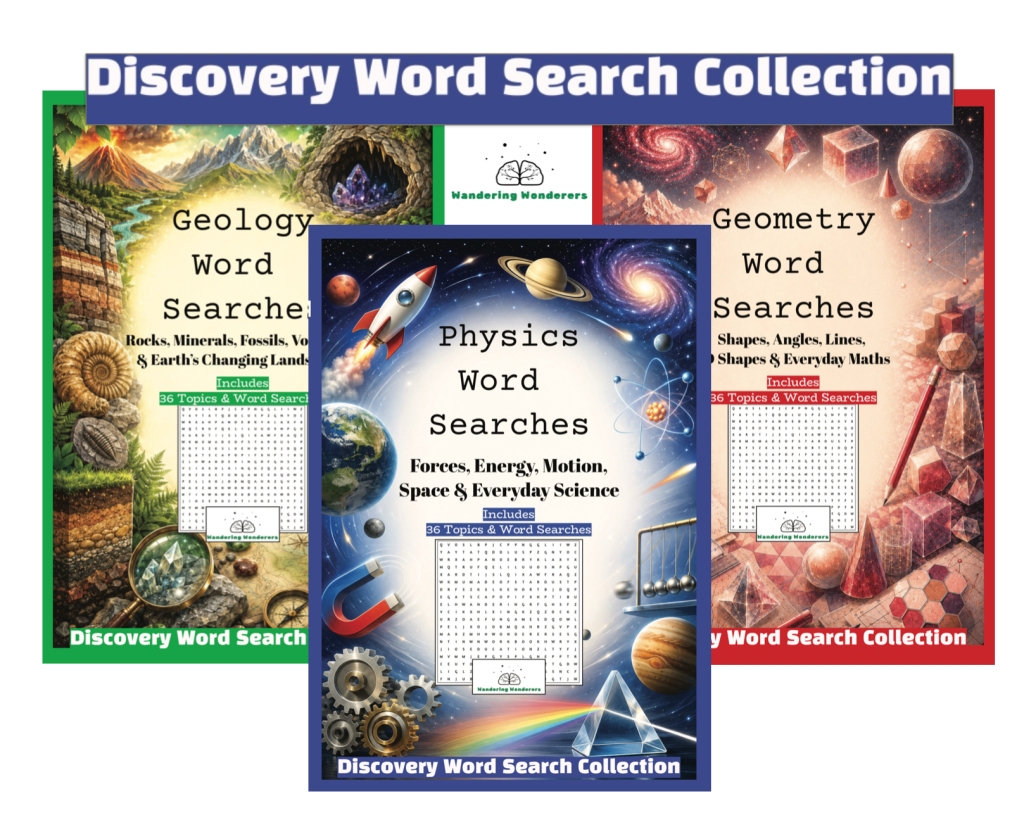
The Discovery Word Search Collection is designed to make learning calm, playful, screen-free and curiosity-led. Each book focuses on a subject or theme and uses simple information pages, topic vocabulary and word search puzzles to support learning through pattern, repetition and discovery.
Books in the collection are created for curious learners, families, home education, topic-based learning, SEN-friendly support, reluctant readers, quiet-time activities and learners with strong special interests.
The series includes science, geography, maths and topic-based word search books, each designed to encourage confidence, vocabulary growth, observation, focus and gentle discovery.
The collection is not intended to replace full lessons or textbooks. It is designed to sit beside learning as a companion resource.
A puzzle can open a topic.
A word can start a question.
A quiet page can support a curious mind.
Geometry Word Searches 2 continues this approach by inviting learners to explore shape properties, angles, circle parts, coordinates, transformations, symmetry, scale, drawing tools and reasoning with shapes.
Search the words.
Notice the shapes.
Discover the geometry around you.


