
Shapes, Angles, Lines, 3D Shapes & Everyday Maths
Part of the Discovery Word Search Collection
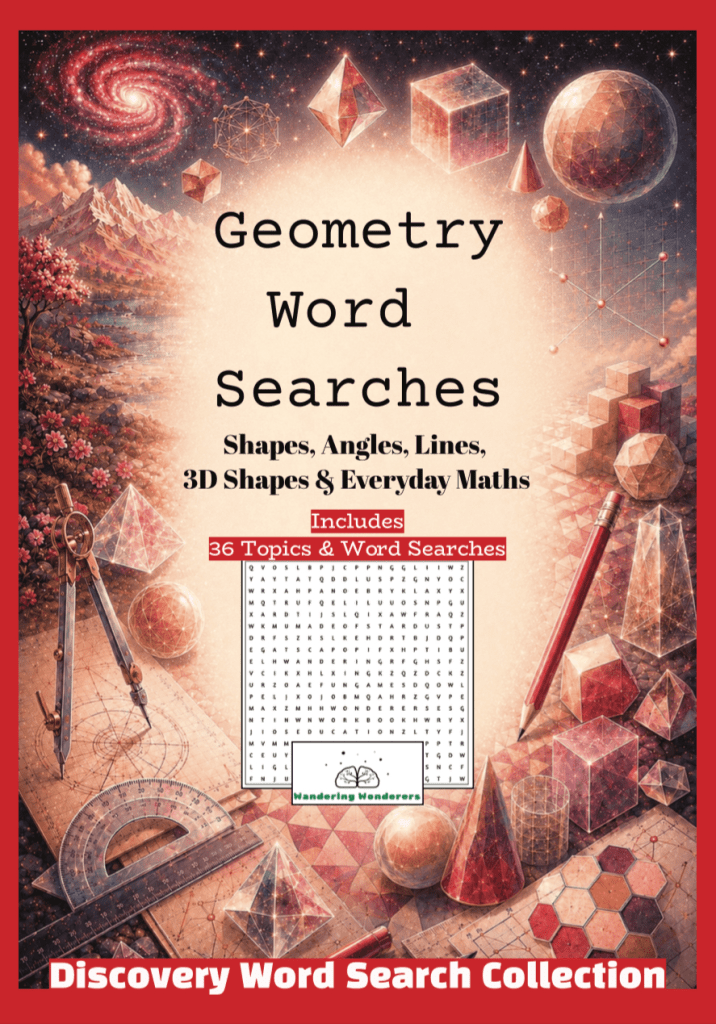
Geometry Word Searches is a calm, engaging and educational puzzle book designed to help learners explore shapes, angles, lines, patterns, 3D shapes and everyday maths through simple explanations, themed word searches and visual learning support.
Created for learners who enjoy puzzles, patterns, visual subjects and manageable learning activities, the book introduces important geometry vocabulary in a gentle, structured way. This helps learners become more familiar with mathematical language before they encounter it in more formal maths tasks.
Geometry is one of the most visual areas of mathematics. It appears in buildings, windows, road signs, clocks, maps, tiled floors, boxes, artwork, toys, nature, packaging and everyday objects.
This book encourages learners to notice shapes, patterns and structures in the world around them.
With 36 themed word searches, simple topic pages and a consistent format, Geometry Word Searches offers a screen-free way to build confidence with maths vocabulary, shape recognition, spatial thinking and careful observation.
What Is Geometry Word Searches About?
Geometry Word Searches introduces learners to key geometry ideas through short, accessible topic sections and themed puzzles.
Each topic focuses on one clear idea. Learners first encounter the topic through simple explanatory text and then explore related vocabulary through a word search. This repeated exposure supports pattern spotting, visual scanning and growing familiarity with mathematical language.
The book covers:
- 2D shapes
- 3D shapes
- Angles
- Lines
- Symmetry
- Position and direction
- Area and perimeter
- Grids and coordinates
- Rotation and reflection
- Nets of shapes
- Geometry review
Rather than serving as a full maths curriculum or textbook, the book acts as a supportive educational puzzle resource. It can be used alongside classroom learning, home education, tutoring, school holiday activities or independent interest-based study.
Book Details
Title:
Geometry Word Searches
Subtitle:
Shapes, Angles, Lines, 3D Shapes & Everyday Maths
Series:
Discovery Word Search Collection
Format:
Educational word search puzzle book with simple topic introductions
Main subject:
Geometry, shape, space, measure and everyday maths vocabulary
Learning style:
Puzzle-based, play-based, visual, screen-free and vocabulary-rich
Who Is This Book For?
Geometry Word Searches is suitable for a wide range of learners, especially those who enjoy visual learning, puzzles, patterns or shape-based activities.
It is suitable for:
- Learners who enjoy maths, shapes, patterns and puzzles
- Learners who prefer visual subjects and clear layouts
- Reluctant readers who engage more easily with short text and puzzle tasks
- SEN learners who benefit from predictable structure and reduced writing demand
- Home-educating families seeking calm maths vocabulary support
- Parents and carers looking for screen-free educational activities
- Tutors wanting gentle reinforcement activities
- Classrooms needing quiet extension, consolidation or early-finisher tasks
- Learners with a special interest in shapes, buildings, patterns, maps or mathematical design
- Families looking for school holiday, travel or rainy-day learning activities
The book is designed to feel approachable rather than overwhelming. Each topic is broken into manageable sections, allowing learners to build familiarity slowly and confidently.
The 36 Topics Included in the Book
- Shapes
- Triangles
- Squares
- Rectangles
- Circles
- Angles
- Right Angles
- Lines
- Parallel Lines
- Perpendicular Lines
- Polygons
- Pentagons
- Hexagons
- Octagons
- Symmetry
- Position
- Direction
- Patterns
- Tessellation
- Area
- Perimeter
- Measuring Length
- Grids
- Coordinates
- 3D Shapes
- Cubes
- Spheres
- Cones
- Cylinders
- Pyramids
- Prisms
- Faces Edges and Vertices
- Nets of Shapes
- Rotation
- Reflection
- Geometry Review
These topics provide a broad introduction to geometry vocabulary. The sequence begins with familiar shapes and gradually progresses to more advanced concepts such as symmetry, coordinates, 3D shape properties, nets, rotation and reflection.
How the Book Supports Learning
Geometry Word Searches supports learning through repetition, recognition and gentle vocabulary practice.
Instead of introducing geometry through formal calculations, the book begins with noticing, naming and recognising. This approach can be especially helpful for learners who need time to become comfortable with mathematical language before applying it in problem-solving.
The word searches help learners practise:
- Geometry vocabulary
- Spelling
- Visual scanning
- Pattern recognition
- Concentration
- Careful observation
- Focus and persistence
- Spatial awareness
- Shape recognition
- Confidence with mathematical language
The repeated puzzle format creates clear expectations and a predictable structure, helping learners focus on the subject itself.
Why Play-Based Learning Matters
Play-based learning allows learners to explore ideas in a relaxed and engaging way.
Although word searches may seem simple, they support a wide range of useful skills. Learners scan rows, columns and diagonals, check spelling, notice letter patterns, compare word shapes and maintain focus on a task.
As a result, word searches provide a gentle bridge between play and learning.
This is particularly valuable in geometry because the subject is highly visual. Learners are not only reading words; they are connecting those words to shapes, diagrams, objects, patterns and real-world spaces.
Play-based learning can help learners:
- Approach maths without fear
- Build confidence through achievable tasks
- Practise vocabulary without formal testing
- Stay engaged for longer periods
- Develop focus and persistence
- Revisit concepts in a low-pressure way
- Connect learning with enjoyment
- Feel successful while still learning
This book uses puzzles as an invitation into maths, encouraging learners to search, notice, compare and discover.
Curriculum Relevance
Geometry Word Searches is a curriculum-relevant supporting resource for mathematics learning across Key Stage 1 and Key Stage 2, with gentle preparation for Key Stage 3.
It supports:
- Shape recognition
- 2D and 3D shapes
- Properties of shapes
- Angles and right angles
- Lines, parallel lines and perpendicular lines
- Position and direction
- Symmetry, rotation and reflection
- Area and perimeter vocabulary
- Measuring length
- Grids and coordinates
- Spatial reasoning
- Mathematical vocabulary
The book aligns particularly well with geometry strands of the maths curriculum, including properties of shapes and position and direction. It also connects with measurement through area, perimeter and length.
While it is not intended to replace formal teaching, it serves as a supportive companion resource that reinforces vocabulary, encourages recognition and builds learner confidence.
Cross-Key-Stage Learning Value
The book offers value across a range of ages and ability levels.
For younger learners, it supports recognition of familiar shapes such as circles, squares, rectangles and triangles.
For lower Key Stage 2 learners, it introduces and reinforces vocabulary linked to angles, polygons, symmetry, area, perimeter and lines.
For upper Key Stage 2 learners, it supports more advanced vocabulary such as coordinates, rotation, reflection, faces, edges, vertices and nets of shapes.
For learners moving towards Key Stage 3, it provides gentle preparation by strengthening familiarity with the language of geometry, measurement and spatial reasoning.
This flexibility makes the book particularly useful when learners need vocabulary reinforcement in a calm and accessible format.
SEN-Friendly and Reluctant Learner Benefits
Geometry Word Searches includes several features that may support SEN learners and reluctant learners.
Key features include:
- Repeated structure throughout
- Short, manageable topic sections
- Clearly introduced vocabulary
- Focused and predictable puzzles
- Visual subject matter
- Low writing demand
- Calm, screen-free activities
- Reinforcement through repetition
For some learners, maths can feel overwhelming when introduced through calculations, abstract symbols or lengthy written tasks.
This book offers another route into learning by beginning with words, shapes, patterns and observation.
Learners can experience success by finding words, recognising shapes and building familiarity one topic at a time.
Colouring Pages and Visual Learning
Because geometry is a visual subject, the book includes black-and-white colouring pages, diagrams and simple shape illustrations.
Colouring activities help learners slow down and notice shape features carefully while supporting focus, fine motor control, visual discrimination and calm engagement.
The visual learning pages include:
- Triangles
- Squares
- Rectangles
- Circles
- Angles
- Right angles
- Parallel and perpendicular lines
- Polygons
- Pentagons
- Hexagons
- Octagons
- Symmetry
- Patterns
- Tessellation
- Area
- Perimeter
- Grids
- Coordinates
- 3D shapes
- Cubes
- Spheres
- Cones
- Cylinders
- Pyramids
- Prisms
- Faces, edges and vertices
- Nets of shapes
- Rotation
- Reflection
- Geometry review
Geometry is everywhere.
These pages help learners visualise each topic before or after completing the corresponding word search.
Examples include:
- Colouring repeating tessellation patterns
- Following perimeter paths around shapes
- Shading areas inside shapes
- Colouring reflected mirror-image shapes
- Tracing rotational movement
- Exploring the features of common 3D shapes
Together, these activities add a creative visual layer to the learning experience.
Everyday Geometry
One of the most helpful aspects of geometry is that it is everywhere.
Learners can spot geometry in windows, doors, tiles, road signs, maps, books, clocks, boxes, packaging, furniture, toys, wheels, art, buildings, nature, patterns, screens, gardens and paths.
Geometry gives us language for describing shapes, spaces, positions and patterns.
A square window, a round clock, a rectangular book, a triangular roof, a tiled floor, a map grid and a cardboard box all contain geometry.
This book encourages learners to look again at ordinary objects and notice the maths hidden within them.
How This Book Can Be Used
Geometry Word Searches can be used in many flexible ways.
At Home
Use it as a quiet educational activity, a screen-free puzzle book or a gentle way to support maths vocabulary.
Home Education
Each topic can become a short geometry lesson. Learners can read the topic page, discuss real-world examples, complete the word search and reinforce learning through colouring activities.
Tutoring
Use the book before or after geometry lessons to reinforce key vocabulary.
Classrooms
The book works well for:
- Early finishers
- Revision
- Consolidation
- Topic introductions
- Quiet work
- SEN support
- Extension activities
School Holidays and Travel
It helps keep maths language fresh without pressure and provides a calm activity for journeys, waiting rooms and holidays.
Special Interests
It can support learners who enjoy patterns, maps, buildings, shapes, puzzles, design, construction or visual thinking.
Why Word Searches Work Well for Vocabulary
Vocabulary is an important part of maths learning.
Before learners can confidently use mathematical terms, they need to recognise them. Geometry includes many specialised words such as vertex, prism, coordinate, perimeter, symmetry, tessellation, parallel and perpendicular.
Word searches provide repeated exposure to these terms. Learners notice spellings, letter patterns and word structures while carefully matching words to lists.
This repetition helps mathematical language feel more familiar.
Importantly, the puzzles are not tests. They provide a gentle and enjoyable way to revisit vocabulary again and again.
Topics That Connect Across Subjects
Geometry connects naturally with many subjects beyond maths.
Art
Shapes, symmetry, patterns, tessellation, rotation and reflection support drawing, design and creative work.
Geography
Maps, grids, coordinates, position and direction connect strongly with location skills and map reading.
Science
3D shapes, measurement, observation and spatial thinking support practical investigations and understanding of objects.
Design and Technology
Nets, 3D shapes, measuring length, area, perimeter and structure connect with planning, building and design.
Computing
Grids, coordinates, position, direction and patterns relate closely to coding, digital design and logical thinking.
Everyday Life
Geometry helps learners understand objects, spaces, packaging, signs, buildings and movement.
These connections make the book valuable not only for maths practice but also for wider curiosity-led learning.
Part of the
Discovery Word Search Collection
Geometry Word Searches is part of the Discovery Word Search Collection.
The Discovery Word Search Collection is a growing series of educational puzzle books designed to make big topics feel more accessible. Each title combines simple explanations, carefully chosen vocabulary and themed word searches to help learners explore a subject one puzzle at a time.
The series is built around curiosity, calm learning and screen-free discovery.
Rather than overwhelming learners with long chapters or heavy tasks, each book breaks knowledge into short, focused topics. This approach makes the series suitable for families, home educators, tutors, classrooms, SEN learners, reluctant readers and curious learners with special interests.
Each book encourages learners to:
- Read a little
- Search carefully
- Notice patterns
- Build vocabulary
- Discover new ideas
- Feel confident with learning
The collection supports learning through puzzles, play and curiosity.
Geometry Word Searches continues this approach by helping learners explore the shapes, patterns and mathematical structures hidden all around them.
Discover Geometry Everywhere
It is in the tiles beneath your feet, the clock on the wall, the map in your hand, the box on the table and the patterns you see in nature.
Geometry Word Searches helps learners slow down, look closely and discover the maths hidden in everyday life.


